All it takes is spotting a dark stain on an awning for the temptation to reach for a strong detergent, a stiff brush or a pressure washer. However, to know how to clean awnings without damaging them, the first step is to understand that many fabrics include protective treatments that can deteriorate if we use the wrong products or techniques.
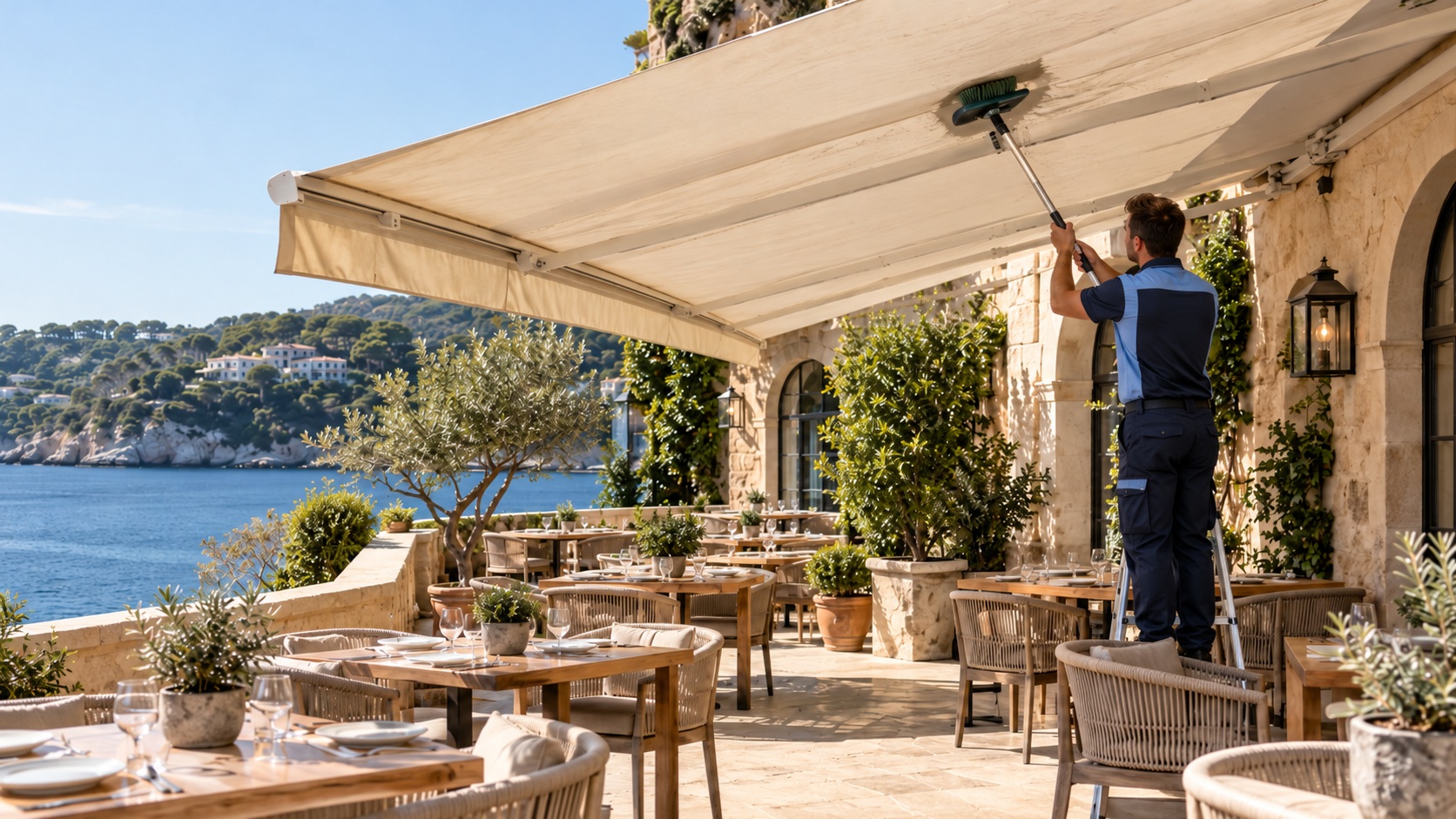
Cleaning an awning should be done carefully, especially when it has been exposed to sun, rain, dust and pollution for several years. In hotel cleaning and restaurant cleaning, where awnings are part of terraces and customer service areas, keeping them in good condition is important for the image of the establishment.
In this guide we explain how to clean a canvas awning step by step, which products are best avoided and how to keep it in good condition without compromising its properties.
What should you check before cleaning an awning?
Before preparing the products, it is worth reviewing two key aspects. This check helps us choose a suitable technique, reduce the risk of damage and decide whether the maintenance can be carried out without specialist help.
Identify the type of fabric and its treatments
The cleaning procedure depends on the material. Many residential awnings use acrylic fabrics, although we also find polyester models, PVC-coated canvas and micro-perforated technical fabrics.
- Acrylic fabrics usually include finishes that improve water repellency and protect the material against certain external agents. If we use products that are too aggressive or apply excessive friction, we can damage these treatments.
- PVC-coated fabrics have different characteristics. Their surface usually allows dirt to be removed with a soft cloth and compatible products, but certain solvents or cleaners can damage the coating.
- Micro-perforated materials, common in some enclosures and solar protection systems, require us to avoid techniques that could distort the weave or trap residue in their small openings.
When we do not know the material, we recommend checking the manufacturer’s or installer’s documentation. If it is not available, we should carry out a test on an inconspicuous area before applying any product.
Check the condition of the fabric and safe access
With the awning extended we can check for open seams, tears, faded areas, build-ups of dirt or spots where the fabric is particularly weakened.
Aged fabric may react badly to intensive cleaning. In these situations it is better to start with a gentle approach and see how the surface responds before continuing.
We also need to check access. An awning installed over a large terrace can be cleaned relatively easily, whereas those on high balconies or façades pose significant difficulties.
We never recommend leaning over a railing, stepping on a roof that is not designed to be walked on or using unstable ladders to reach the top of the awning. When the whole surface cannot be reached safely, the right thing to do is to call in professionals who have the necessary equipment.
How to clean an awning step by step without removing it
In many installations, routine maintenance can be carried out without removing the fabric from its frame. To achieve a good result we need to work methodically and follow the manufacturer’s care instructions.
Step 1 – Remove dust and surface dirt
With the fabric dry and fully extended, we start by removing leaves, dust, insects and any other debris that has built up on the surface.
For this task we use a soft-bristle brush or a tool that removes dirt without scratching the fabric. Movements should be gentle and follow a consistent direction, paying particular attention to folds and seams.
It is important to carry out this first step before wetting the awning. If we wet a surface covered in dust or sand directly, we can create a layer of dirt that is harder to remove.
When there are abrasive particles, such as wind-blown sand, it is not advisable to scrub hard either. The best approach is to remove them carefully so they do not act like sandpaper on the fabric.
Step 2 – Apply water and soap without damaging the fabric
After brushing, we can prepare a solution of lukewarm water with a small amount of neutral soap, provided it is compatible with the manufacturer’s recommendations.
We apply it with a sponge, a microfibre cloth or a soft brush. It is best to work in sections, spreading the product evenly and avoiding concentrating it on a single spot.
If we find stains, we can use gentle movements and leave the product to act for the indicated time. It is not advisable to keep working on the same area, as this can cause colour differences or surface wear.
We should also avoid cleaning during the hottest hours of the day. Strong sunlight can dry the product before rinsing and lead to rings or residue.
Step 3 – Rinse thoroughly and let it dry before retracting
Once the dirt has been removed, we use clean water to remove any soap residue. We can use a hose with a gentle spray, making sure the water does not hit the fabric with excessive pressure.
Rinsing must be thorough, especially on seams, folds and areas where product may build up. Detergent residue can leave marks or make it easier for dirt to stick again.
Then we leave the awning fully extended until it has air-dried completely. This step is essential to prevent moisture from being trapped when the fabric is rolled up.
If we retract a fabric that is still wet and it stays like that for a long time, the risk of odours, stains and mould growing on accumulated organic residue increases.
That is why we recommend choosing a dry day without strong wind and with enough time to complete the process.
How to remove the most common stains from awnings
The source of the dirt determines how we should act. As a professional cleaning company, before applying special products we need to check whether the dirt can be removed with gentle cleaning and whether the manufacturer allows other treatments to be used.
Mould and green algae stains
Persistent moisture, combined with dust and organic matter, can lead to dark or greenish stains. This is a relatively common situation on awnings located in patios, gardens or areas with limited ventilation.
To begin with, we recommend removing surface dirt and trying a clean with water and a compatible soap. If the stains persist, we need to check which specific solutions the fabric can take.
Not all dark stains can be removed completely. When mould has been present for a long time or has penetrated the fabric, a mark may remain even after the dirt has been removed.
In these cases it is especially important to avoid aggressive remedies applied without knowing the material. Some manufacturers allow specific treatments under controlled conditions, while others advise against certain products. We should never automatically transfer a recommendation from one fabric to another.
Bird droppings and organic residue
Bird droppings can stick firmly, especially when they are left exposed to the sun for several days. Trying to remove them dry with a rigid tool can damage the fabric or the seams.
The best approach is to wet the stain locally with water and let the residue soften. We can then remove it with a soft sponge, without scraping or applying excessive pressure.
If a mark remains, we apply a small amount of compatible cleaner and carefully repeat the process. Several gentle passes are better than trying to remove everything with intense scrubbing.
Regular cleaning helps prevent these situations. The less time residue stays on the fabric, the easier it usually is to remove.
Accumulated dust, sand and salt
On terraces and in gardens in Mallorca, awnings commonly collect particles carried by the wind, soil, vegetation and the sea air.
Dust can build up in folds and seams, while sand creates an additional problem because of its abrasive nature. That is why these particles should be removed before using a damp sponge or brush.
In areas close to the coast we may find salt deposits on exposed surfaces. A gentle rinse with fresh water, provided the material allows it, helps remove this residue.
We should also check the metal components of the awning. Arms, brackets and mechanisms may need specific maintenance, although we must avoid wetting motors, electrical connections or components that the manufacturer says should be protected.
Which products and tools should you avoid when cleaning an awning?
The urge to remove a stain quickly can lead us to use common household cleaning products that are not designed for outdoor fabrics.
Is it advisable to use KH7 or other degreasers?
This type of product can be effective at removing grease on compatible surfaces, but that does not mean it is suitable for every fabric.
Degreasers are usually formulated for specific applications. Using them on technical fabrics without checking compatibility can affect the colour, the protective finishes or the materials that make up the awning.
If we are thinking of using KH7 to clean awnings, we should check the specific formulation and the surfaces listed on its label. We do not recommend applying a household degreaser across a whole fabric when there is no explicit indication of compatibility.
For routine maintenance we prefer to start with water and a mild soap approved by the manufacturer. When there is a stubborn grease stain, the right approach is to identify the fabric and choose a specific product.
Can awnings be cleaned with a Kärcher?
Although pressure washers are very useful for many outdoor cleaning jobs, using them on awning fabric can cause damage if the manufacturer does not expressly approve the procedure.
The impact of high-pressure water can damage protective treatments, affect the seams or deteriorate weakened areas of the fabric. The risk increases when the nozzle is held too close or a concentrated jet is used.
That is why we advise against using a household Kärcher directly on the fabric as a regular method. Manufacturers such as Sauleda and Dickson recommend avoiding high-pressure washers on certain awning fabrics.
For conventional rinsing, the most prudent alternative is to use a hose with a gentle flow and spread the water without subjecting the surface to strong impacts.
Risks of using bleach, vinegar and harsh products
Some home remedies may seem effective because they quickly change the appearance of a stain. However, they can also alter finishes, cause discolouration or affect certain fibres and seams.
Bleach should not be used as an all-purpose awning cleaner. Although some manufacturers give specific recommendations for spot treatments, its use depends on the fabric, the authorised concentration and the product instructions.
Vinegar is not a valid solution for every material either. Its acidity may be incompatible with certain finishes or components, so it is best avoided when there is no explicit recommendation.
We should never mix cleaning products ourselves, especially bleach with vinegar, ammonia or other incompatible cleaners, as dangerous reactions can occur.
We also recommend avoiding abrasive scourers, wire brushes, solvents and tools that could scratch the fabric.
How often should awnings be cleaned in Mallorca?
There is no single frequency that works for every installation. Maintenance depends on the type of fabric, the location, the environmental conditions and how the awning is used.
In coastal areas of Mallorca, proximity to the sea can encourage salt deposits to build up. In rural areas it is more common to find dust, pollen and plant debris, while in urban settings there may be particles from traffic and commercial activity.
As a general guideline, we recommend carrying out regular visual checks and removing leaves, dust and other debris before they build up.
A more thorough clean can be scheduled once a year, provided the condition of the awning and the manufacturer’s recommendations allow it. In particularly exposed spaces it may be advisable to increase the number of interventions. To organise maintenance, we can use these guidelines:
- Monthly check: look for leaves, dust, recent stains, organic residue and the visible condition of the seams.
- Surface cleaning when needed: remove deposits before they stick or build up.
- Annual maintenance clean: carry out a more thorough intervention, following the manufacturer’s instructions.
- Extraordinary check: inspect the awning after episodes of heavy dust, wind, muddy rain or significant build-up of debris.
In restaurants, hotels, shops and businesses with terraces, maintenance may need to be more frequent due to use and the presentation of the space.
When is it better to call in a professional cleaning service?
There are situations in which trying to do the job yourself can be impractical or even dangerous.
- Awnings installed on upper floors, façades, hard-to-reach inner courtyards or large structures require special assessment. If we cannot reach the whole fabric from a safe position, we should avoid improvised solutions.
- We also recommend requesting a professional assessment when we find extensive mould stains, heavily ingrained dirt, delicate fabrics or materials whose protective treatments are unknown.
- On motorised awnings, complex structures and large textile enclosures, it is important to protect the mechanisms and understand the limitations of the system.
- When a fabric has tears, damaged seams or a significant loss of its properties, cleaning can improve its appearance, but it is not the same as repairing the material.
That is why we distinguish between removable dirt, permanent stains and fabric deterioration. Before intervening we need to establish what result can reasonably be achieved and what risks the job involves.
How we look after awnings at Nord Baleares
Our awning cleaning service in Mallorca is aimed at homeowners, residential communities, shops, restaurants, hotels and businesses that need to keep their shade structures in good condition.
At Nord Baleares we understand that every awning needs an individual assessment. Before intervening we check the type of fabric, its general condition and the characteristics of the installation. Based on that assessment we select the right products and procedures, paying attention to protective finishes and to the elements that require special care.
We also offer cleaning and maintenance services for professional premises where the upkeep of terraces, entrances and outdoor surfaces is part of the establishment’s image.
If you need to clean the awnings of a home, residential community or business and would rather leave the job to professionals, you can contact our team. We will assess the characteristics of the installation and prepare a proposal tailored to your needs.