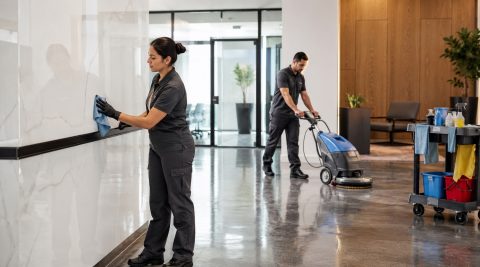
Subrogation in cleaning companies is one of the most important and often least known aspects when a community of owners or a company decides to change providers.
In our experience, this process raises many questions: What happens to the employees? Is it mandatory to take them on? What responsibilities does the new company have? A thorough understanding of how the transfer of employment works prevents legal problems and ensures a smooth transition without conflict.
Below, we’ll explain clearly and practically what subrogation entails, when it applies according to the cleaning agreement, and what both communities and companies should keep in mind. At Nord Baleares, we work with these types of situations every day, especially in cleaning and maintenance services for communities in Mallorca, so we have firsthand knowledge of the most common mistakes and how to avoid them to ensure a continuous, high-quality service.
What is subcontracting in a cleaning company?
The transfer of a cleaning company is the process by which, when a homeowners’ association or a company changes providers, the new company must take on the workers who were already providing the service. In other words, it’s not just a change of company, but also a continuation of the staff performing the cleaning tasks.
In our experience, this mechanism is designed to protect workers’ rights and guarantee job security, preventing them from losing their jobs every time there is a change in contractor. At the same time, it allows the service to continue without interruption, which is especially important in communities, offices, or spaces with daily cleaning needs.
When does it apply?
It is mandatory when the collective agreement for the cleaning sector so establishes and a series of conditions are met.
- It is activated when there is a change of company awarded a cleaning service that has been provided continuously, as happens in homeowners associations, offices or shopping centers.
- It is necessary that the workers be assigned to the service for a specific period and that the requirements established in the collective agreement be met, such as seniority or working hours linked to the workplace. Therefore, each case must be analyzed individually, since not all situations automatically imply the obligation to transfer the staff.
Difference between subrogation and change of company
One of the most common mistakes is thinking that changing cleaning companies always implies automatic transfer of employment, when in reality they are different concepts. Changing companies simply refers to replacing the service provider, while transfer of employment implies the obligation to retain the workers who were performing that work.
In practice, this means that there can be changes of company without subrogation if the legal or collective agreement requirements are not met.
However, when the transfer of employment contracts is applicable, the new company cannot freely choose the staff; instead, it must take on the existing employees under the established conditions. Understanding this difference is key to avoiding conflicts, claims, and legal problems for both the community and the incoming company.
Subrogation according to the cleaning agreement
It is primarily regulated by the collective bargaining agreement applicable in each territory. This agreement establishes the conditions, requirements, and procedures that must be followed when a change of employer occurs.
What does the collective bargaining agreement for cleaning say?
It specifically regulates the obligation to transfer staff when the company providing the service changes. In most cases, it establishes that the new contractor must take on the workers assigned to the workplace, respecting their working conditions, seniority, and acquired rights.
The agreement also defines the deadlines, communication obligations between companies, and the documentation that must be exchanged. This ensures a transparent and orderly transition, avoiding uncertainty for both employees and customers.
Requirements for subrogation to exist
For a transfer of employment to occur, it is not enough for there to be a change of company; a series of requirements established in the agreement must be met.
- One of the main requirements is that the worker is effectively linked to the service or workplace, usually for a minimum period of time before the change.
- Factors such as the type of contract, working hours, and continuity of service are also taken into account. In our daily practice, we see that one of the most common mistakes is failing to properly verify these requirements, which can lead to future conflicts if the transfer of employment is not implemented correctly.
Mandatory documentation between companies
One of the key aspects of any transfer of undertaking is the exchange of documentation between the outgoing and incoming companies. This information is essential for the new company to properly take on the employees and fulfill all its labor obligations.
The most common documentation includes employment contracts, payroll records, seniority certificates, work schedules, outstanding vacation days, and any incidents. Managing this process correctly is essential to avoid administrative errors and ensure a smooth transition, without affecting service or employee rights.
Subrogation of workers in homeowners' associations
When a community decides to change companies, it is not only hiring a new provider, but may also be assuming the continuity of the staff who were already performing those tasks.
In our experience, this point often raises many questions among community presidents and administrators, as the true scope of the transfer of rights is not always clear. Understanding how it works is key to making informed decisions and avoiding legal problems or service disruptions.
How it affects communities of neighbors
When a residents’ association changes cleaning companies, the transfer of contracts can mean that the same workers continue providing the service, albeit under a new company. This ensures continuity, which is very positive, as the staff are already familiar with the building’s facilities, routines, and specific needs.
However, this also means that the community cannot freely demand a change of staff if the transfer requirements established in the collective agreement are met. Therefore, it is important to consider this factor before deciding to change companies, as the service may continue to be provided by the same professionals.
Obligations for property managers
Property managers play a key role in cleaning company change processes, as they are usually responsible for managing the hiring process and coordinating the transition. Their responsibilities include ensuring that the transfer of services is carried out in accordance with the collective bargaining agreement and that the necessary information is shared between the parties involved.
They must ensure that the community complies with its legal obligations, avoiding decisions that could lead to labor disputes or claims. In our experience, good management by the administrator is essential for a smooth and secure transition of ownership without disrupting the community’s daily operations.
Obligations of the new cleaning company
When a subrogation occurs, the incoming company assumes the provision of the service and a series of labor obligations with respect to the workers who join.
Rights of subcontracted workers
The transferred employees retain their employment rights after the change of company, meaning they cannot be adversely affected by the new service contract. This includes aspects such as job security, recognition of their seniority, and respect for their contractual conditions.
In practice, this ensures that the worker can continue to perform their job normally, without needing to sign a new contract from scratch.
Seniority, salaries and working conditions
One of the most important aspects is that the incoming company must respect the employee’s seniority, salary, and all other working conditions they have enjoyed. This includes working hours, job title, type of contract, and other acquired rights.
This is not about starting a new employment relationship, but about continuing the existing one under a new company. Therefore, any modifications to these conditions must comply with current labor regulations, avoiding unilateral changes that could lead to claims or disputes.
Legal responsibilities of the incoming company
The company that takes over the service also assumes legal responsibilities towards the transferred workers. This includes complying with obligations regarding social security, occupational risk prevention, and wage payments from the moment the transfer takes effect.
You must ensure that all documentation received is correct and complete, as any errors may lead to further problems.
Is it possible to avoid outsourcing cleaning services?
In most cases, it is not an option that the company or the homeowners’ association can freely choose. However, there are specific situations in which subrogation is not applicable.
Therefore, before making decisions such as terminating a cleaning contract in a homeowners’ association, it is essential to thoroughly analyze the case to determine whether or not this obligation actually exists and to avoid subsequent legal problems.
Cases in which subrogation does not apply
The transfer of employment contract does not apply when the requirements established in the collective agreement are not met. For example, the employee may not be actually assigned to the service or may not have reached the minimum seniority required at that workplace.
It is also possible that the service will not be continuous, meaning there is no direct replacement between companies, but rather an interruption or a substantial change in the service provided. In these situations, the new company may not be obligated to take on the staff, although it is always advisable to review each case in detail.
Legal risks of trying to avoid it
Attempting to avoid a mandatory transfer of employment contracts can have significant legal consequences. From employee claims to financial penalties, the risks can affect both the incoming company and, in some cases, the homeowners’ association itself.
A bad decision in this process can lead to labor disputes, unexpected costs, and legal problems in the medium and long term.
Case law on subrogation in cleaning companies
The issue of employee transfer has been the subject of numerous court rulings, particularly in the context of homeowners’ associations and outsourced services. Case law has clarified how collective bargaining agreements should be applied and what happens in situations where there are doubts about the obligation to take on employees.
Relevant cases in homeowners’ associations
The courts have resolved numerous disputes related to changes in cleaning companies. In many cases, they have upheld the obligation to take over the employees when the business activity continues and the service remains the same.
There are also resolutions where it has been determined that subrogation is not appropriate, for example, when the actual assignment of the worker to the service is not proven or when the seniority requirements are not met.
Court interpretation
It usually focuses on one key principle: continuity of service. If the activity continues and the workers were effectively linked to the workplace, the obligation of subrogation is usually recognized.
Judges assess factors such as the documentation provided, the organization of the service, and the worker’s actual relationship with the center. Therefore, what is stated in the contracts is not enough; the practical situation is analyzed to determine whether or not the transfer of employment is appropriate.
Most common legal consequences
When the transfer of employment contracts is not implemented correctly, the legal consequences can be significant. One of the most common is a claim for unfair dismissal by the employees, which can result in substantial financial compensation.
Joint and several liability may also arise between companies or penalties resulting from labor non-compliance.
Common problems in cleaning subcontracting
In our experience, these errors not only affect the companies involved but also the quality of service. This is especially critical in sensitive tasks such as cleaning communal garages, where continuity and organization are key to maintaining the facilities in good condition.
Lack of information between companies
One of the most common problems. If the documentation is not submitted correctly or contains errors, the new company may encounter difficulties managing the employees from day one.
This can lead to issues with payroll, working hours, or working conditions. Therefore, it is essential that the exchange of information is clear, detailed, and within the established deadlines, thus avoiding administrative and labor-related problems.
Labor disputes and claims
Workers can file complaints if they believe their rights have been violated, which may lead to legal proceedings or compensation claims. In many cases, these disputes arise from misinterpretations of the collective bargaining agreement or decisions made without proper legal advice.
Common mistakes in communities
In homeowners’ associations, the possibility of transferring the existing contract is often overlooked before changing cleaning companies. This can lead to unrealistic expectations, such as the belief that the entire cleaning team can be completely replaced from the outset.
It is also common not to verify whether the requirements for subrogation are met or not to properly coordinate the process with the property manager.
Nord Baleares, a cleaning company specializing in residential areas of Mallorca
We have extensive experience managing cleaning services for homeowners’ associations and residential complexes in Mallorca. We understand that every change of company requires improvement and proper management of key aspects such as employee transfer, coordination with property managers, and operational continuity.
We take care of analyzing each situation in detail, anticipating possible incidents and offering effective solutions that guarantee a stable, organized and quality cleaning service from day one.